VENTURI / Technical insight
Why flow alone is not enough to size a control valve
Quick answer
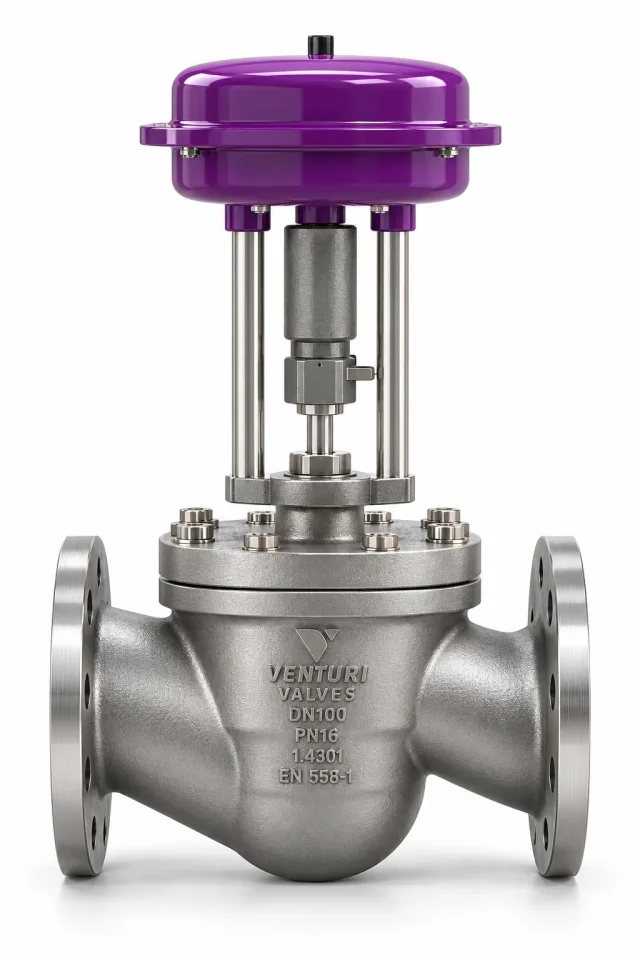
Control valves vary their opening through an actuator and control signal. Selection starts with minimum, normal and maximum flow and inlet/outlet pressures. Consider Kv/Cv, characteristic, cavitation, noise, positioner and fail position together.
Overview
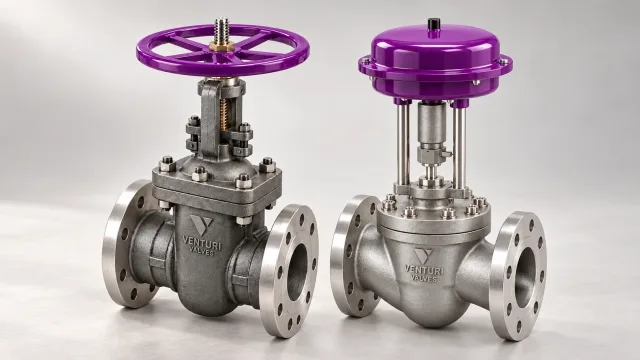
Control valves vary their opening through an actuator and control signal. Selection starts with minimum, normal and maximum flow and inlet/outlet pressures. Consider Kv/Cv, characteristic, cavitation, noise, positioner and fail position together.
How is an actuated valve selected?
Define valve torque or thrust, differential pressure, operating time, control signal and fail position together. Ambient conditions and the required protection rating also affect selection.
Review the complete operating range
Share minimum, normal and maximum conditions instead of one design point. Density, vapour pressure, inlet temperature and allowable noise support correct sizing.
Let’s specify the right valve.
Contact Venturi for selection and technical verification against your application requirements.
| Item | Required data | Also verify |
|---|---|---|
| Liquid | Flow, P1/P2, temperature, density, vapour pressure | Cavitation, flashing and viscosity |
| Steam | Mass flow, absolute pressures and steam condition | Critical flow, velocity and noise |
| Full operating range | Minimum, normal and maximum operating points | Controllability, trim and actuator |
Contact Venturi for selection and technical verification against your application requirements.